
Jodi Taylor
I'm thrilled to launch Behind the Manuscript with bestselling author Jodi Taylor. The Chronicles of St Mary’s is one of my favorite series. Some books become more than favorites; they become comfort reads, the ones you return to when you want to visit old friends. Jodi’s books have become that for me.
As a developmental editor, they've become just as rewarding to read. I'm always impressed by how Jodi keeps beloved characters true to themselves while weaving them through centuries of history, interconnected series, and long-running storylines. The time travel is brilliantly crafted, but it's the people who keep me coming back. Her books are full of humor, suspense, romance, found family, and relationships that continue to deepen.
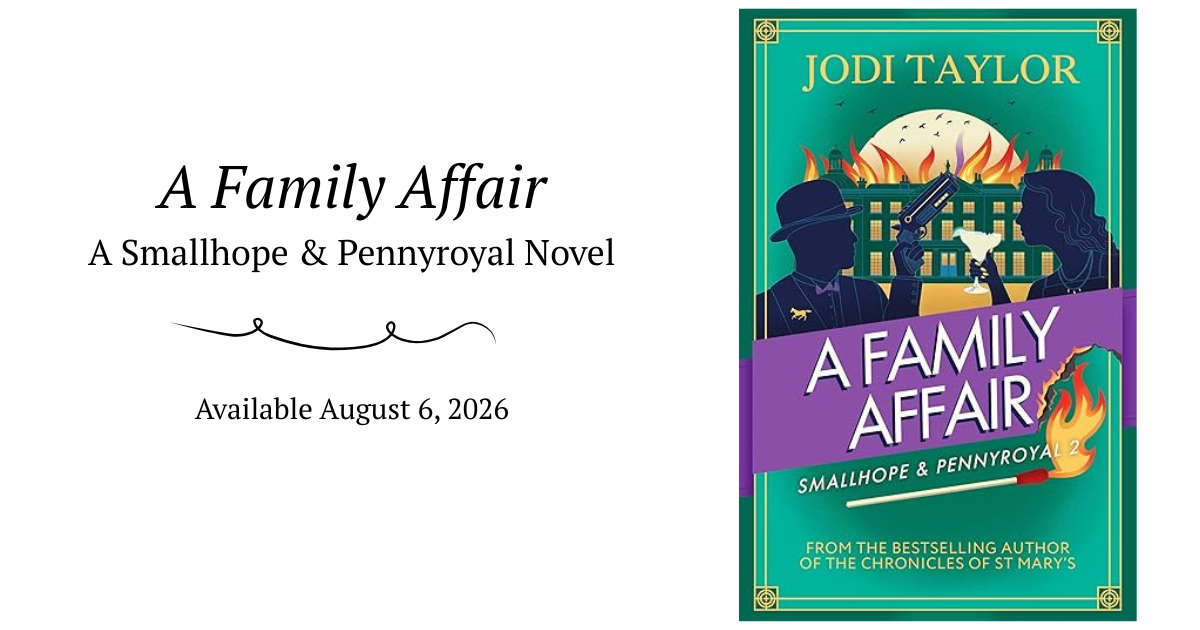
In this conversation, Jodi shares how Smallhope and Pennyroyal evolved from secondary characters into leading a series of their own, why the Smallhope family became so memorable (yes, we talk about the peacocks), how she approaches revisiting familiar St Mary's moments from a new perspective, and what readers can look forward to in A Family Affair, releasing August 6, 2026.
I hope you enjoy our conversation as much as I did!
The Interview
You've created memorable characters across several interconnected series, and many of them move between those worlds. When prior secondary characters like Smallhope and Pennyroyal step into a different series or become the focus of a new story, how do you preserve the voice readers know while revealing a side of them they haven't seen before?
A tricky question to begin with!
In a way this was fairly simple to achieve with Smallhope and Pennyroyal since my readers first encountered them as adults and fully-fledged bounty hunters. The characters in The Ballad of Smallhope and Pennyroyal are much younger – Smallhope is only about sixteen – which enabled me to show her as a teenager and just give subtle hints of the person readers knew she would become.
Pennyroyal, I suspect, has been Pennyroyal since birth and will never change. I could just imagine him frightening the midwife to death!
One of my favorite parts of The Ballad of Smallhope and Pennyroyal was how the Smallhope family's stories and little quirks made them feel like people I'd known for years. I loved the peacocks. How do you decide which seemingly small character details become recurring threads that deepen both the family dynamics and the larger story?
Well, I’d love to be able to say I sat down and planned everything very carefully but, sadly, that’s not actually true. I’m famed for the typical Taylor failure to plan ahead. I wanted to open the story with a scene setting up Smallhope, her background, her family, the eccentricities of her family and so forth, and so I had her father hanging out of his study window shooting at the peacocks living in the grounds.
I should at once say that he never stood the slightest chance of hitting any of them – and probably didn’t want to, anyway. Lord Goodrich is easily the worst shot in the county. The role of the peacocks grew from that scene. Peacocks obviously play a role in the lives of the Smallhope family. From there I had the idea of putting them on the family crest, and writing the scene at her father’s funeral when all the peacocks assemble to say farewell. And then, being sensible birds, they take one look at the dastardly Caroline and push off, only to return when Smallhope herself returns to Starlings.
The family background – Black Ralph from the Middle Ages and his wife, Perfectly Normal Agnes just came to me as I was inventing their family tree. I expect a lot of other colourful details will emerge as the story progresses.
And family is very important to Smallhope – she has a strong sense of who she is, together with a sense of duty and responsibility. As she often says, Duty before pleasure – always. Which makes Caroline exiling her from Starlings only days after her father’s death even more cruel and heartless.
Pennyroyal, of course, has no family, but the death of his sister was obviously a massive thing for him to deal with. Unsuccessfully, of course. Killing everyone he considered responsible is probably not the best way to deal with that particular trauma. I wonder if that’s going to come back to bite him one day.
Another joy of The Ballad of Smallhope and Pennyroyal is revisiting familiar St Mary's moments from a new perspective. What was the biggest creative challenge in weaving those scenes into Smallhope and Pennyroyal's story? Can you tease whether A Family Affair will revisit any more familiar scenes from the wider St Mary's universe?
In one way, having an existing framework on which to hang the story made things easy. There were certain fixed points, certain fixed storylines that had to appear. All I had to do was weave a story that incorporated those details.
The idea of writing the story of Smallhope and Pennyroyal came to me while I was writing The Good, the Bad and the History, when Smallhope and Pennyroyal are fighting off Insight in the cellar and Pennyroyal suddenly abandons her to take his own personal revenge on someone. I didn’t dwell on it in that book but basically, he just left her there. His partner. How would she feel about that? What effect would that have on their partnership and their relationship? Writing those emotionally charged scenes was good fun.
I think Smallhope and Pennyroyal will always be connected with St Mary’s. We’ll see them in A Family Affair. And the Time Police, too, because there are one or two loose ends to tidy up. For example – what happened to the kidnapped Romulus? We are about to find out.
One thing I appreciate is that your characters remain themselves no matter which historical period they find themselves in when they time travel (my apologies to everyone at St Mary's). Each one reacts according to their own personality, experiences, and relationships, even as the world around them changes dramatically. How do you approach building that consistency across so many different historical settings?
Actually, I don’t think people do change that much. Parts of a person’s character may be deeply hidden – for eg, someone might, deep down, have reserves of courage and determination of which even they themselves are unaware, and they draw on these reserves in a crisis, but they didn’t suddenly acquire that courage. It was always within them. I think that, whether trapped in the Great Fire of London, or involved in the destruction of Persepolis, or trying to prevent the Gunpowder Plot, the basic core of a person would remain unchanged. And let’s not forget all historians are bonkers anyway.
Smallhope and Pennyroyal remain consistent in their dealings with the world. Smallhope shouts, ‘When things are bad – make them worse,’ and Pennyroyal simply shoots everyone in sight.
“They didn’t suddenly acquire that courage. It was always within them.”
Now that Smallhope and Pennyroyal's story has been established, how does writing their second novel differ from writing their origin story? What new opportunities or challenges did that create as a storyteller?
It was both easy and difficult at the same time. The second book offered me more freedom in that I wasn’t so closely bound to an existing story. I could wander off-piste a little if I wanted to. At the same time there were threads left over from other stories that needed to be addressed so there were still episodes and scenes that had to be built in.
And there are themes common to both books, of course. Family – especially in the second book – and revenge is still pretty high on Smallhope’s To Do list, and Caroline’s ghastly family simply won’t go away. Now, however, I do feel that I’ve filled in most of the blanks and can start bringing in new threads. For example, Smallhope and Pennyroyal have been targeted. By whom? And, frankly, who would dare?
Although your books are known for history, adventure, and plenty of chaos, what stays with me most are the relationships. Whether it's romance, friendship, or found family, those emotional connections seem to be the heart of the story. How do you develop those relationships so they feel just as compelling as the larger adventures unfolding around them?
Well, initially, I only intended to write one book – Just One Damned Thing After Another – and most of my characters died at the end of it. I was talked out of that – luckily – and was able to go on and develop both the characters and the overarching storyline.
There are usually three main themes; the voice of the narrator – Max or Smallhope; the historical event in which they are entangled; and the voice of St Mary’s/the Time Police/Starlings itself, which I try to show through the voices of the people within them.
And I’ve been in the forces where everyone is, to some extent, dependent upon everyone else, and trusts them to have their backs. I tried to make St Mary’s very similar to the RAF during WW2, when life expectancies were horribly short – especially for aircrew – so life tended to be lived to the full and stress was dealt with by indulging in any number of daft escapades hardly less lethal than actual hostilities. Plus, of course, the British habit of exchanging deadly insults with the people you like and respect best.

About Jodi Taylor
Jodi Taylor is the internationally bestselling author of the Chronicles of St Mary's, Time Police, Elizabeth Cage and Smallhope & Pennyroyal series. Famous for her witty, fast-paced stories packed with history, adventure and time-travelling chaos, she has delighted millions of readers around the world. She lives in Gloucestershire, where she continues to write and occasionally attempts to keep history on track.
Learn more at joditaylorbooks.com
Bio courtesy of Jodi Taylor
Thank you for reading Behind the Manuscript. I hope these conversations help readers discover the creative decisions behind the books they love and give writers a deeper appreciation for the craft behind unforgettable stories. Until next time. Happy reading.
